A HISTORY OF NSW 1
© John Potter NPCC 37, EUR 343, ALPCA 2598
Over the years a number of articles and photographs have appeared in the newspapers regarding the NSW 1 number plate.
By using these resources and some research this is what I have discovered about NSW’s first number plate.
For me, this history starts with two men, Alfred Edward and George Oswald Hyde.
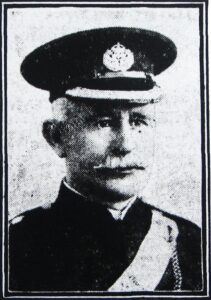
Alfred Edward was the Superintendent of the Police Traffic Branch, and was the ultimate authority in NSW for the issuing of the first number plates. Of undoubted athletic ability, he was at first employed as a public servant before being transferred to the NSW Police Department.
Although forgotten now, he was at the time considered to be one of the fathers of cycling in Australia, as he was the first person to cycle from Sydney to Melbourne in 1884. He travelled the 571 miles in 8 ½ days, on a 52 inch Bayliss & Thomas ordinary (the term used in those days for what we now call a penny farthing). In 1913 he donated this machine to the Sydney Bicycle Club for their display.
He was involved in traffic management for over 30 years from the era of horse drawn cab and bus to the motor car, until his retirement in February 1920.
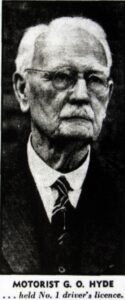
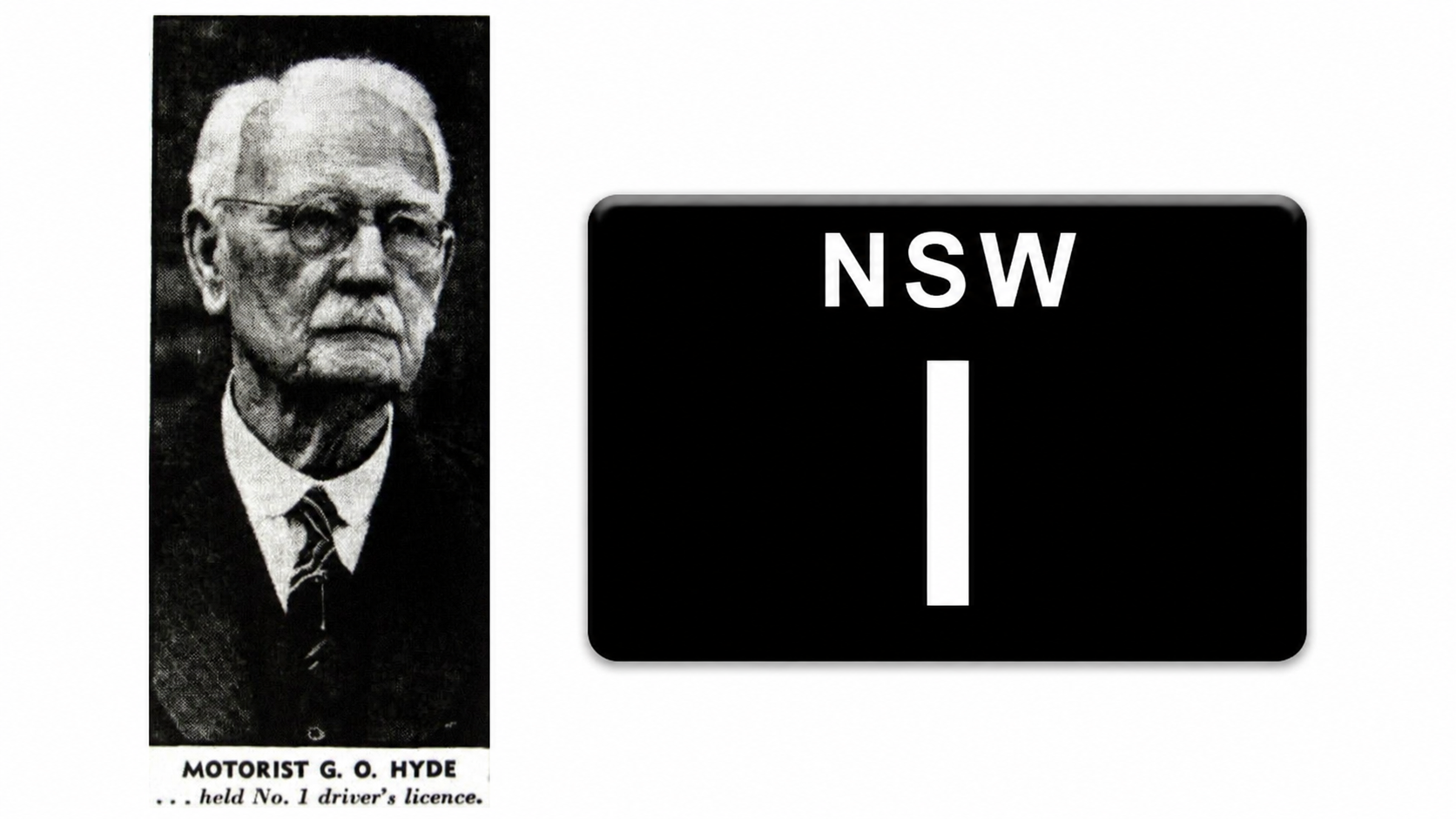
George Oswald Hyde was a man of influence in early motoring in NSW, being issued by Alfred Edward, the first drivers’ licence in NSW and also, twice, the first number plate to be issued to a member of the public.
As plates 1 to 34 were to be reserved for Government Departments, he was issued the first plate available to a member of the public, plate 35. And, eventually, in 1919 he was issued the ultimate prize, plate number 1.
Background. In 1888 a Transit Commissioner was appointed to control and supervise the increasing horse drawn traffic of Sydney. They acted independently of the Metropolitan Police Force.
Mr Alfred Edward was appointed Registrar and Chief Inspector to the Metropolitan Transit Commissioners on 17th October, 1888.
With the introduction of the faster moving electric trams, the Commissioner was found to be unable to cope with this situation and the government moved to introduced the Metropolitan Traffic Act of 1900.
With this act the Transit Commission was abolished and traffic control transferred to the Inspector General of Police along with as far as possible the Commission staff to the newly formed Police Traffic Branch. On the 30th August 1900, Alfred Edward was made Superintendent of the Traffic Branch.
1910 onward. When the Motor Traffic Act of 1909 came into force in 1910, the Traffic office consisted of 12 police officers and a clerical staff of 6, headed by Mr Edward.
In 1910 motoring in general and the owning of a motor vehicle in particular was the preserve of the wealthy. It was these wealthy members of Sydney society that had years previously on the 20th March 1903, formed The Automobile Club of Australia, the first such car club in Australia.
Club members were influential in the formulation of the licensing and registration regulations of the 1909 Motor Traffic Act. The Police did not have any vehicles and it is doubtful if many police officers would have even driven a car. As such it was two members of the Automobile Club of Australia, Charles Sherwood and Henry Skinner that were the State’s first driving and licensing instructors.
George Hyde was also an influential member of the automobile club and claims:
Numbers 1 to 34 were held back for some years for distribution, if necessary, to Government departments.
The first issue of number plates was discussed with him by the then Superintendent of Traffic, Mr. Alfred Edwards.
“It was the superintendent’s original intention to hold back only 10 plates, but on my suggestion, he changed this to 34,” said Mr, Hyde.
“He did not consider that motoring would take on, but I thought otherwise, and at the superintendent’s request I attended his office to receive the first plate, numbered 35, and the first licence, numbered 1.”
(The Sun, 16/3/1941, page 10)
The Holderness Motoring Guide of March 1915 indicates that 7 number plates (3, 6, 8, 9, 10, 14, and 34) were held by various government departments and 10 plate numbers (1, 2, 4, 5, 11, 12, 15, 16, 23, 31) were retained by the Traffic Office. The remaining 17 plates (7, 13, 17 – 22, 24 – 30, 32 and 33) had been reissued to, and were held by, members of the public.
Plate 35 was still held by George Hyde, of the Athenaeum Club, Sydney and was registered on a 30hp Wolseley.
So, it seems that the original idea of having the low numbers held by the various Departments was dispensed with, and as Government vehicles were disposed of, the number plates were returned to the Traffic Office and not transferred to either new or other vehicles held by the respective Departments.
The only exception to this is plate 10, as it is the only one of the original 34 that remains with the same authority that it was issued to, the NSW Fire Brigade. It is the longest single registration in NSW and probably Australia. The plate is recognised as an NSW Fire Brigade heritage item, helping to ensure that the plate will remain in their hands.
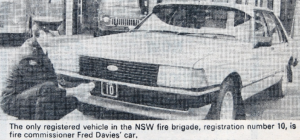
(Financial Review, 18/7/1980, page 29)
No doubt there would have been pressure being applied to Alfred Edwards, by the wealthy and influential of Sydney society to reissue these low numbers, and of course over the next few years this lobbying was successful.
Again, there is one exception, and that is plate number 6. It was originally held by the Tramways Department, and after being returned to the Traffic Office, it was not reissued until the NSW Department of Motor Transport held the Great Plate Auction and released a set number of surrendered and originally unissued numeric plates, in November 1983.
I don’t know when plate No. 2 was reissued but in November 1923, probably as a bit of business self-promotion, the following newspaper article appeared.
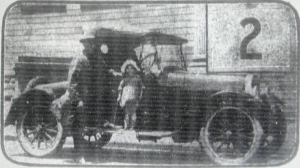
THE LOWEST-NUMBERED CAR IN USE. – This 1921 Model Studebaker, Number 2, is owned by Mr. H. M. Williams, of Williams’ Garage, Newtown, and is the lowest number in use. No. 1 plate is in the Traffic
Office. Mr. Williams first had this number on a ‘Daimler,’ and it has been on his present car for three months.
(Evening News, 21/11/1923, page 14)
On the 14th anniversary of the issuing of the first NSW number plate, the following photograph and caption were printed.
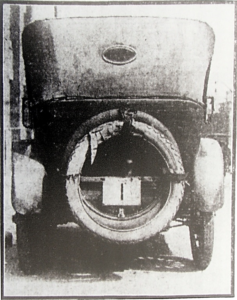
“The story of No.1 is interesting
It was originally placed upon a Daimler car, which was used by the government. The car was known as the Premier’s car.
It was registered by Alfred Edward, Superintendent of Police Traffic, on March 10, 1910.
From 1913 to 1919 the number was not issued.
In May 1919, No. 1 was issued to George Oswald Hyde, of Bridge St., Sydney.
Some time ago Mr. Hyde notified the Traffic Department that he would not be using the number for a while but that he intended purchasing a new car later on, and requested that the number 1 be, therefore, retained for him.
On January 7, 1924, Mr. Hyde having notified the Traffic Department that he had now a new car, No. 1 was again issued to him to place on a new fawn coloured touring Buick.
Mr. Hyde is still the registered owner of No. 1.”
(Evening News, 10/3/1924, page 6)
Note that plate 2 does not carry the NSW legend, suggesting to me that it is the 1910 original issue and not a remake.
I ordered a copy of the picture of plate 1 hoping for a clearer image but unfortunately it wasn’t any better. By enhancing the image, it seems that there is a small NSW legend at the top, suggesting the plate has been remade.
It is very fortuitous that these photos exist at all, as during 1924 the plate colours were reversed and the black on white plates were replaced by white on black plates. At the same time the owner was required to provide their own front plate.
So, Mr Hyde’s Buick carried this plate for only a year before it was replaced with the smaller enamel white on black plate.
In 1980 it was reported that in 1918 plate No. 8 was ‘won’ by the father of Margaret Spain. A former Tramway Department plate, no doubt reissued at the discretion of Alfred Edward.
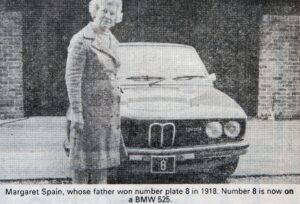
(Financial Review, 18/7/1980, page 29)
In September 1927 a newspaper report was printed about the “Lure of Numbers – Money in Them”
In Sydney recently one car owner offered another car owner £100 for the transfer of his number plate.
It is related also that another Sydney motorist ‘swopped’ his comparatively new and expensive car for an archaic rattletrap, simply that he might secure its number.
The greatest prize of all, of course, is No.1. But it is beyond the reach of the car number hunters.
Mr. G. O. Hyde, of North Sydney, is its possessor, and he does not intend to part with it.
Originally, numbers up to 34 were reserved for Government cars, and Mr. Hyde was issued with plate No. 35. In the following year there was a re-arrangement of numbers, and the Traffic Branch wrote to Mr. Hyde asking him whether he would care for No. 1. Mr Hyde jumped at the offer, and was agreeably surprised when the department made him a gift of the two original No. 1 plates.
(The Sun, 14/9/1927, page 10)
There were also requests by businesses to acquire specific numbers and Mr. Edwards entertained this by issuing some companies their specific plate requests. The whisky maker John Walker & Sons Ltd secured plate 1820 (the year they were established), the firm which handles a well-known brand of eau-de-colonge has plate 4711 and the Phoenix Insurance Co. succeeded in landing 1782, which is the date when the company started business. In fact, it was reported that plate 4711 was issued out of sequence.
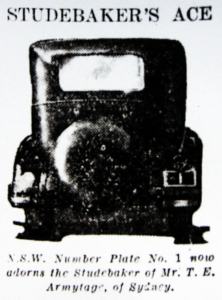
In January and March 1929, articles appeared in three newspapers that were basically commercials for Studebaker cars.
“The first number plate issued in New South Wales is still held by the same motorist Mr G. O. Hyde according to the Studebaker Corporation.
Mr Hyde also holds driver’s license No. 1. The number plate has been used on many cars since Mr Hyde first became a motorist.
In recent years he transferred it temporarily to a relative, Mr T. E. Armitage, managing director of the Sydney Furnishing Factory who selected a new Studebaker model. Like Mr Hyde he has been a motorist for many years.
Studebaker has something of a monopoly of the ‘1’ numbers. The car driven by their courtesy man attracts considerable attention because its registered number is 111-111.” (Evening News, 25/1/1929, page 6)
A very poor photo of the Studebaker appeared in the Newcastle Sun, on 29/1/1929, page 3
However, there was trouble on the horizon when the temporary agreement or arrangement, that had been mentioned in the newspaper report as being made between George Hyde and Thomas Armitage, ended in a court case.
“The question of who was the rightful owner of motor car number plate, No. 1, arose in the Central Police Court, when George Hyde, of Mosman, charged Thomas Armitage with attempting to defraud him of it.
Hyde said he had held No. 1 for a number of years, having had it presented to him by the Superintendent of Traffic. Finally, when he was without a car, Armitage, with whom he was friendly, told him, “You can put it on my car.” This was done, on the condition that the car was registered in Hyde’s name. Later, Armitage had attempted to transfer the number plate without getting his consent.
Mr. Holt (for Armitage) said the plate was the property of the NSW Government. Hyde had no legal right or title to it, and therefore could not be defrauded.
Mr. Penny (for Hyde), said he was not asking for the return of a plate belonging to the government, but for one belonging to Hyde.
Mr. McMahon, S.M., dismissed the information.”
(The Sun, 27/3/1930, page 13)
Probably due to the effects of the Depression, Thomas Armitage’s financial position was dire and the court case win was short lived, as by 17th April 1930 there was a deed against him for payment of a dividend (3s. 4d. in the £1) to his creditors. On the 31st December 1930 there was a sequestration (bankruptcy) order against him. Consequently, his estate was put up for sale along with the car that carried plate No.1. The car and plate were bought by Frederick Stewart for £250. It seems probable to me that Armitage knew he was in financial difficulties and reneged on the agreement, knowing that the sale of NSW 1 would cover some or all of his debts. It also appears that Mr. Stewart was not a newcomer to obtaining low numbered plates as his second wife disclosed to the Canberra Times on the 28th September 1961, that he had previously, at various times, obtained the rights to plates 2, 5 and 7.
Background of Mr. Stewart. Stewart started his business enterprises by buying and subdividing a parcel of land in 1919 in what was then rural Chullora. As there was no rail or tram services available, he started his own transport service with a second hand bus and by the mid-1920s it was the largest private bus service in Sydney, employing 4,000 people at its peak.
Diversifying, he was a founding member of Australian National Airways with Charles Kingsford Smith and Charles Ulm in the late 1920s.
In December 1931 he won the Federal seat of Parramatta for the United Australia Party, and in the same year donated money to build Stewart House in Curl Curl a northern beach suburb of Sydney. This was a home for under nourished children during the depression, that is still ongoing. In 1933 he helped establish the radio station 2CH, and its aerials were on his 40 acre property at Dundas.
In 1935 he embarked on an extensive overseas tour as the headlines indicated.
No. 1 Car will Tour the World.
Car No. 1 on the NSW registry of motor vehicles is off for a trip round the world next week.
During its wonderings it will help substantially in the study of employment relief systems abroad. It will poke its dignified nose into the affairs of the International Labor Office at Geneva, where its owner will seek information on one of the world’s vital problems.
Car No. 1 is the property of Mr. F. H. Stewart, the Parliamentary Under Secretary for Employment, and is the largest private car on the Australian roads at present.
It is fitted with a wireless, and there is ample room in the tonneau for a secretary and a typewriter.
Some years ago, he purchased another car in order to secure the coveted number plate.
Mr. Stewart, who is leaving this week for England, will be away about seven months. His tour will embrace Germany, Italy, and other European countries where attempts to solve the unemployment problem have reached an interesting stage.
He will return via America and Canada and will use his car as combined transport and office on most of the journey.
(The Sun, 10/3/1935, page 9)
Although this travel was privately funded, taking his wife and three daughters with him, there was some criticism, as he was accompanied by a government paid public servant (Mr. Eric Harding) acting as private secretary.
While in London he took part in the Silver Jubilee Celebrations on behalf of the Commonwealth, and was the Australian representative at the International Labour Convention in Geneva.
I found one report that in September while in Canada he conferred with the welfare minister (M. Croll) relative to Ontario’s methods of handling unemployment relief and social welfare. So, it was a real working holiday, before the term backpacker came into vogue.
During his overseas travel he was awarded a knighthood in June 1935 because of the benevolent work he had pursued before and after he entered parliament. He returned to Australia as Sir Frederick Stewart in early November.
He would have called in at the Australian Embassy in London, so somewhere out there, I am sure a photo of NSW 1 outside Australian House exists. There would be family and probably official photographs, just waiting to be discovered.
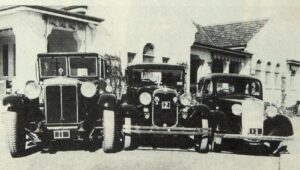
The following year this well-known photograph, that was taken outside Sir Frederick Stewart’s home at Dundas, appeared in The Sun newspaper on the 18th May 1936. The reason for the photograph was that all three owners lived in the Parramatta area. No.2 was on a Ford Coupe owned by Mr W. Y. Hunt, of Hunt Bros (Sydney) Motors, and No. 3 on a Vauxhall owned by Mr R. C. Thomas, a Parramatta dentist.
As can be seen in the photo Sir Frederick’s car was huge, being a 12 cylinder Daimler that was unique in Australia.
Another well-known photograph of No. 1 appeared in the newspaper in early 1950 when there was some discussion of recalling the numeric series during the preparations for the introduction of the uniform plate system.
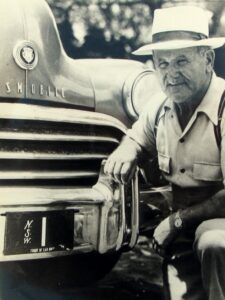
“No. 1 car in NSW. Numberplate NSW 1 belongs to Sir Frederick Stewart, South Steyne, Sydney. He has had the number for 30 years, but fears that it might be recalled when NSW adopts the three-letter three-figure system.” (Sun Herald, 22/1/1950, page 4)
After his death in June 1961 the plate passed into his second wife’s hands and it has been reported on and photographed a number of times.
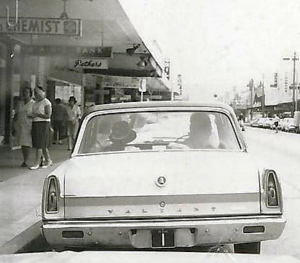
This photo was taken by Mathew Jennings (#769) father in about 1970. He had followed the car for some time until it stopped in Penrith, enabling the photo to be taken.
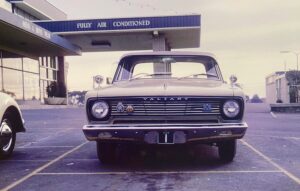
This valuable colour photograph showing the front of NSW 1 was taken by David Jobson -the Aussie Built Cars Facebook page
This photo appeared in the paper in an article commenting on the recently introduced NSW custom plate series. Luckily, I happened to see the plate in about 1981 on the Illawarra Highway when I was working in the Bowral area.
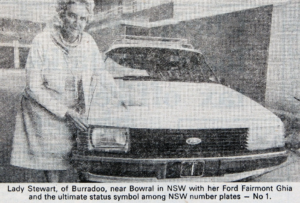
(Financial Review, 18/7/1980, page 29)
This photo appeared in the paper with a report about the large increases in the prices realised after another numeric plate auction.
Lady Stewart is sentimental about the plate, “I’m not prepared to sell, though there have been many offers over the years. I realise it’s the most important number plate in Australia. But whatever happens it will always be very public because people have always been interested in it,” she says.
When the owner of plate No. 2 died (Mr. Jack Shaw) his family put the plate up for auction, and on the 14/9/2003 it sold for $683,200 (see NPCC Oct. 2004). It was then the highest price paid for an NSW number plate.
On the 28/8/2017 Mr Peter Tseng (already the current owner of Plate No. 2) paid $2,450,000 plus $122,500 buyers’ premium for plate No. 4, setting another record.
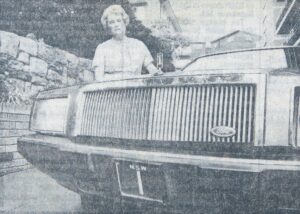
(SMH, 1/1/1986)
After the death of Lady Stewart plate NSW 1 was passed not to her stepchildren or their descendants but to a relative from her side of the family. The plate is currently on hold and has not been seen on the road for some 20 years.
See Craig Jeffriess (#132) article.
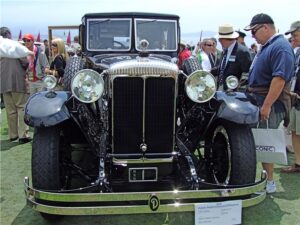
Sir Frederick’s legacy lives on, as his former world travelled Daimler has been fully restored and now resides in the USA. As recognition of its history the car carries replica NSW 1 plates, and the photo of the front of the vehicle was taken on the 18/9/2010 at the Pebble Beach Concourse in California.
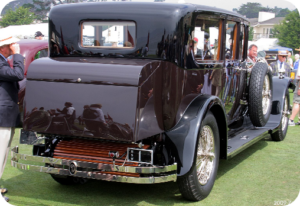
The photo of the rear of the vehicle is from the 2009 concourse.
Notice also that the concourse version now has a chrome bumper and two spare wheels that were not present in the 1936 photo.
The owners displaying the vehicle in 2010 are Robert & Barbara Lorkowski, of Bruce, Wisconsin.